Webhooks vs Polling: A Practical Guide for Integration Builders
Key takeaways
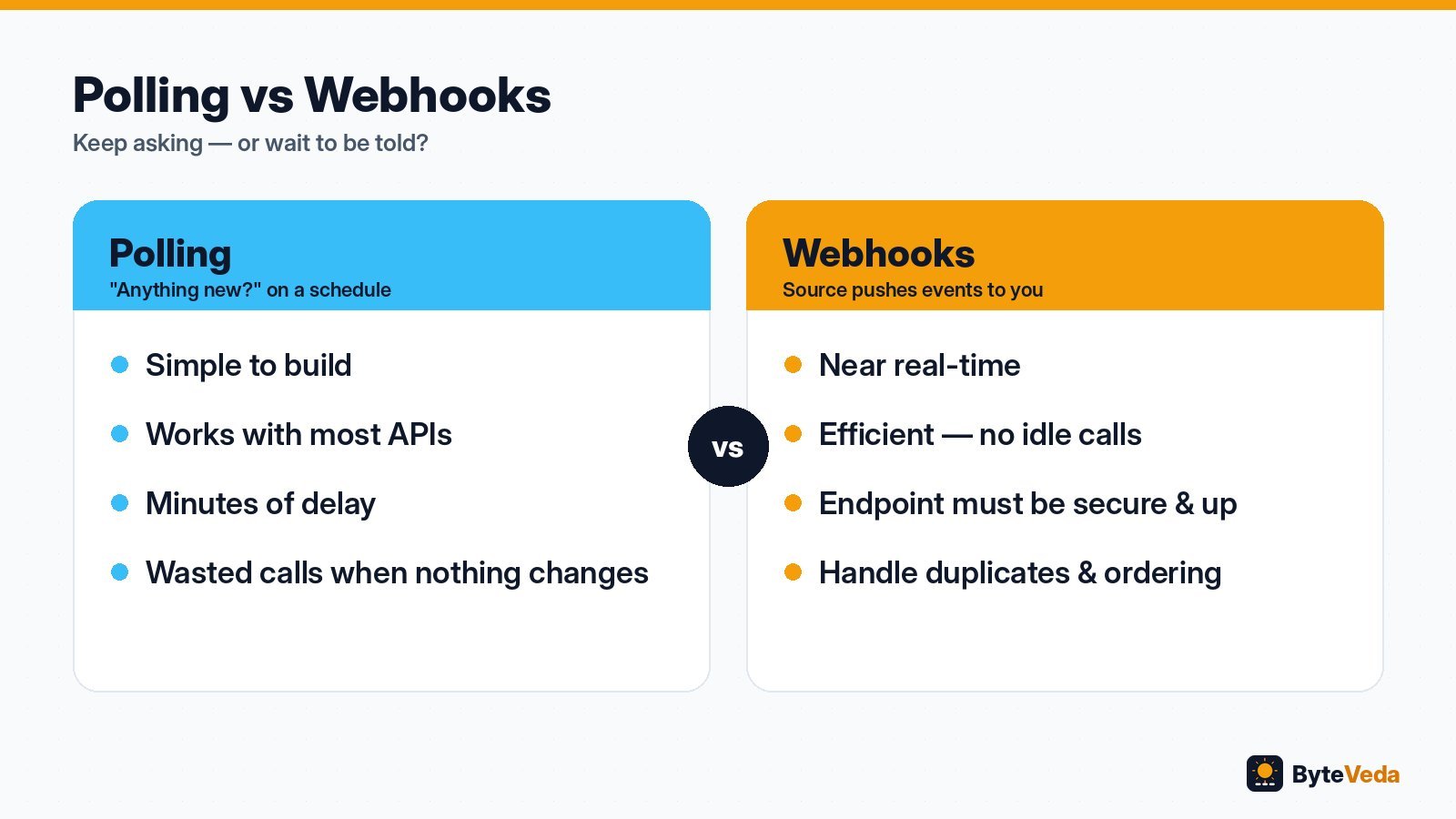
- Polling: your integration keeps asking “anything new?” on a schedule.
- Webhooks: the source system tells you the moment something happens.
- Webhooks are faster and more efficient; polling is simpler and more predictable.
- Reliable designs often combine both — webhooks plus a reconciliation poll.
Every integration needs to know when something changed in a source system. There are two basic ways to find out: keep asking, or wait to be told.
Polling: “anything new?”
Your integration calls the source system’s API on a schedule — say every five minutes — and asks for records created or updated since the last check.
Strengths
- Simple to build and reason about.
- Works with almost any API that supports filtering by date.
- You control the timing and load.
Weaknesses
- Delay: changes are picked up only at the next poll.
- Wasted calls when nothing has changed.
- Can hit API rate limits at short intervals.
Webhooks: “here’s what just happened”
You register a URL with the source system. When an event occurs — a contract is signed, a record is updated — the source sends an HTTP request to your URL with the details.
Strengths
- Near real-time.
- Efficient: no calls when nothing happens.
- Scales well with event volume.
Weaknesses
- Your endpoint must be available, secure and fast.
- Events can arrive twice, out of order, or not at all.
- Not every system offers webhooks for every event.
Quick comparison
| Polling | Webhooks | |
|---|---|---|
| Latency | Minutes | Seconds |
| Efficiency | Lower | Higher |
| Complexity | Low | Medium |
| Missed events | Rare (if cursor is correct) | Possible without retries |
| Best for | Batch syncs, simple sources | Status changes, user-facing updates |
Making webhooks reliable
- Verify signatures. Confirm each request genuinely came from the source system.
- Respond fast, process later. Acknowledge immediately, then process from a queue.
- Be idempotent. Use event IDs so a duplicate delivery does not create a duplicate record.
- Fetch the latest state. Treat the webhook as a notification and re-read the record from the API, which also handles out-of-order events.
- Reconcile. Run a periodic poll to catch anything that slipped through.
Pro tip
For polling, store a “last successful sync” timestamp and query slightly before it — a small overlap window — so records updated during the previous run are never missed. Idempotent processing makes the overlap harmless.
Webhooks for speed, polling for safety. The most reliable integrations use both.
Which should you choose?
Use webhooks when users expect updates to appear quickly and the source system supports them. Use polling for batch processes, simple sources, or when webhooks are not available. For anything business-critical, add a reconciliation job regardless.