AI Agents Explained: What They Are, What They Aren’t, and Where They Work Today
Key takeaways
- An agent is a system where the model decides the next step, using tools, in a loop.
- Workflows are predictable; agents adapt. The best systems combine both.
- Agents work best on multi-step, information-heavy tasks with human review.
- Keep humans in charge of irreversible actions like payments and external emails.
“Agent” may be the most stretched word in technology right now. Chatbots are called agents. Workflow automations are called agents. Sometimes a single prompt with a nice interface is called an agent.
This matters, because businesses are making buying and building decisions based on the label. So let us be precise.
A working definition
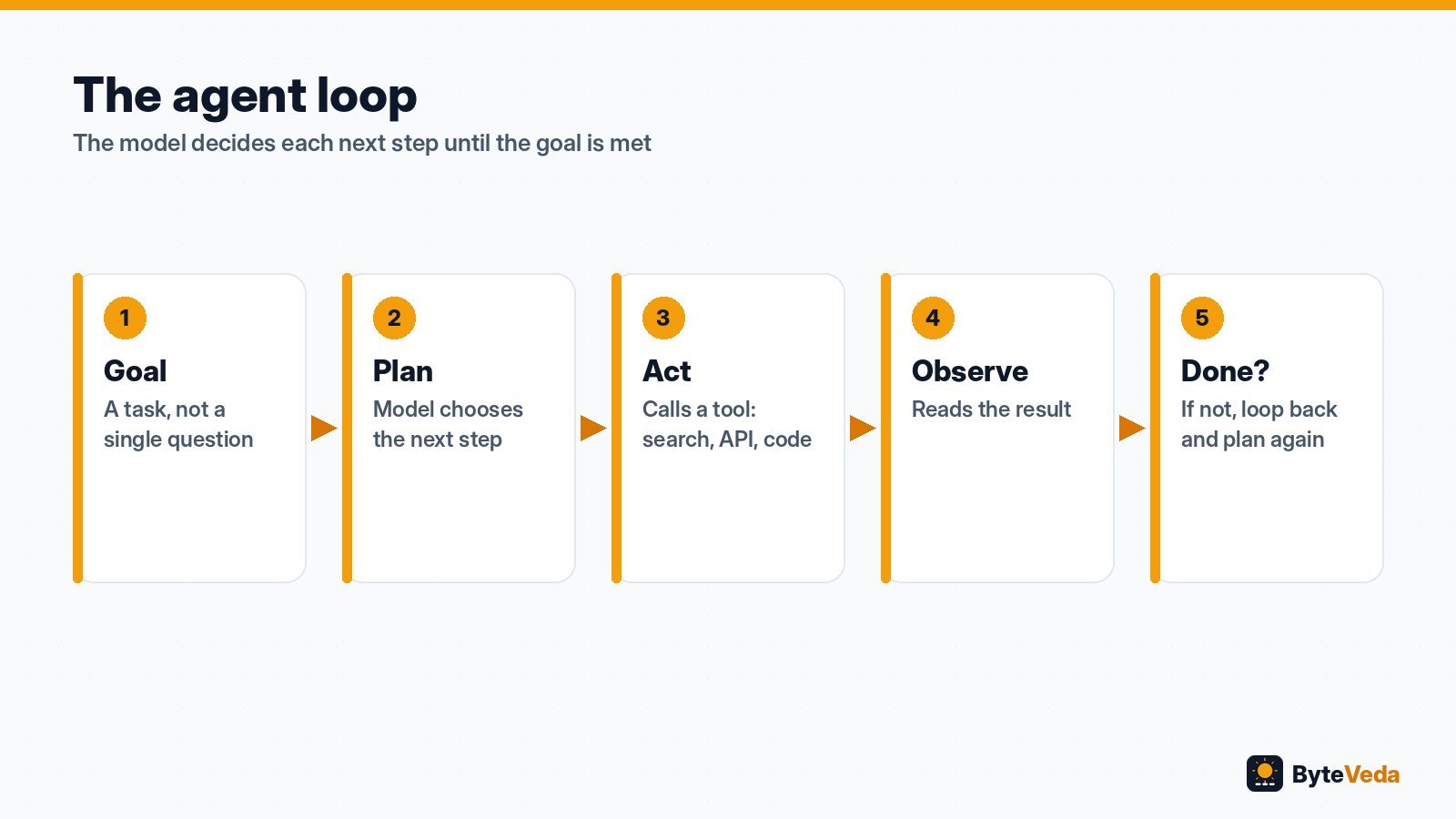
An AI agent is a system where a language model decides what to do next — which tool to call, what information to fetch, whether the task is finished — in a loop, to reach a goal.
Three ingredients make something agentic:
- A goal, not just a single question. (“Prepare a summary of all contracts expiring next quarter and draft renewal reminders.”)
- Tools the model can use: search, databases, APIs, code execution, email, a browser.
- A loop where the model observes results and chooses the next step, rather than following a fixed script.
If a human or a fixed flowchart decides every step, it is automation. If the model decides the steps, it is an agent.
Chatbot vs workflow vs agent
| Chatbot | Workflow | Agent | |
|---|---|---|---|
| Who decides the steps? | Nobody — one turn | A fixed flowchart | The model |
| Uses tools? | Rarely | Yes, fixed ones | Yes, chooses which |
| Predictability | High | Very high | Medium |
| Best for | Quick Q&A | Repeatable processes | Multi-step, variable tasks |
A workflow example: when a contract is signed, create a record in the ERP, then notify finance. Predictable, auditable, and often the right answer. An agent, by contrast, plans and executes its own sequence, adapting to what it finds.
Many of the best production systems are hybrids: a reliable workflow with one or two steps where a model makes a judgment call — classifying a document, extracting fields, deciding which queue a request belongs to.
Where agents work well today
Agents deliver the most value when tasks are multi-step, information-heavy, and tolerant of review:
- Research and synthesis. Gathering information from several sources and producing a draft report.
- Coding assistance. Reading a codebase, making changes, running tests, and fixing what fails.
- Operations triage. Reading incoming requests, gathering context from several systems, and proposing an action for a human to approve.
- Data cleanup. Working through messy records, flagging duplicates and inconsistencies.
- Document-heavy back-office work. Reviewing contracts against a playbook, preparing summaries, drafting standard responses.
The common thread: a human stays in the loop at the point where mistakes are costly.
Where agents still struggle
- Long, open-ended tasks without checkpoints. Small errors compound over many steps.
- Actions that cannot be undone. Payments, deletions, sending external communications. These need explicit approval gates.
- Poorly documented systems. An agent is only as good as the tools and data it can access. Messy APIs and inconsistent data trip agents up just as they trip up new employees.
- Unclear success criteria. If you cannot describe what “done” looks like, neither can the agent.
If you cannot describe what “done” looks like, neither can the agent.
Designing an agent that people trust
If you are building or buying an agent for business use, look for these properties:
- Narrow scope first. One well-defined job beats a general “assistant for everything”.
- Least-privilege tools. Give read access before write access; give write access only to what the task needs.
- Human approval for irreversible steps. Draft the email, do not send it — until trust is earned.
- Full activity logs. Every tool call and decision should be visible for review and audit.
- An evaluation set. Real tasks with known good outcomes, run before every change.
The bottom line
Agents are real, useful, and improving quickly — but they are not magic employees. The winning pattern today is workflows for the predictable parts, agents for the judgment-heavy parts, and humans for the decisions that matter.
Start with one painful, repetitive, multi-step task. Measure the time saved and the error rate. Expand from there.