

7 Prompting Habits That Get Better Answers from AI at Work
Key takeaways
- Give context like you would to a smart new colleague.
- Specify the format, share examples, and say what to avoid.
- Break big tasks into steps and iterate with specific feedback.
- You stay responsible for checking facts and figures.
Most disappointing AI answers come from vague requests. The model is not lazy — it is guessing what you want. The good news: a handful of habits close most of that gap, and none of them require technical skills.
1. Give the context you would give a new colleague
Imagine handing the task to a smart new hire on their first day. They would need to know who it is for, why it matters, and what good looks like.
Weak: “Write an email about the project delay.”
Better: “Write a short email to a client’s legal operations lead explaining that the contract migration will finish one week later than planned because their data export arrived late. Tone: calm, factual, no blame. Offer a 20-minute call this week.”
2. Say what the output should look like
Length, format and structure are easy to specify and make a big difference.
- “Three bullet points, under 15 words each.”
- “A table with columns: risk, impact, owner, next step.”
- “One paragraph for an executive, then technical detail below.”
3. Share examples of good work
If you have a previous email, report or summary that you liked, include it and say “match this style.” Examples communicate tone and structure better than any description.
4. Ask it to think before answering
For anything involving analysis, reasoning or decisions, ask the model to work through the problem first:
- “Before you answer, list the assumptions you are making.”
- “Consider at least two alternative approaches and explain why you chose one.”
This surfaces weak reasoning early and gives you something concrete to correct.
5. Break big tasks into steps
Instead of “write the whole project proposal”, work in stages:
- Agree the outline.
- Draft one section at a time.
- Review and tighten.
Each step gives you a chance to steer before errors compound.
6. Tell it what to avoid
Constraints are as useful as instructions:
- “Do not invent numbers — mark any figure I need to fill in as [TBD].”
- “Avoid jargon; the reader is not technical.”
- “Do not mention client names.”
The first one is especially important for anything going to a customer or leadership.
7. Iterate instead of starting over
The first answer is a draft. Reply with specific feedback — “shorter”, “more direct in the opening”, “the second point is wrong because…” — and the model will usually improve quickly. Specific feedback beats regenerating and hoping.
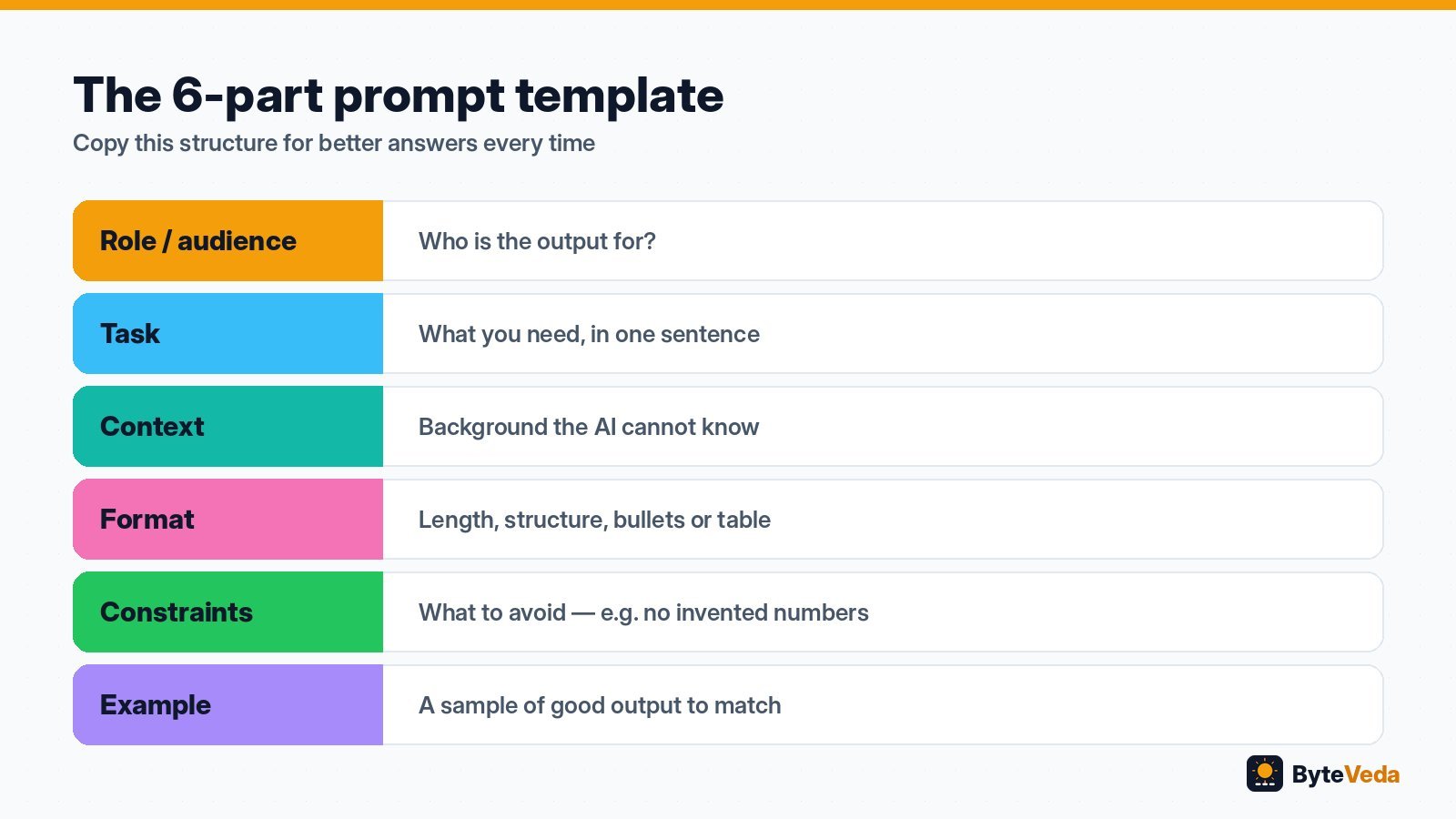
A reusable template
When in doubt, use this structure:
Pro tip
Save your best prompts in a shared document. A team prompt library turns one person’s good habit into everyone’s.
One rule above all
You remain responsible for the output. Check facts, figures and anything that will be sent externally. AI is an excellent first-draft partner and thinking aid — the judgment is still yours.