

Vata, Pitta and Kapha: A Simple Introduction to the Three Doshas
Key takeaways
- Ayurveda describes three doshas — Vata, Pitta and Kapha — as combinations of the five elements.
- Each person is said to have a unique balance of the three, called prakriti.
- The tradition uses this framework to guide diet, routine and lifestyle.
- It is a traditional system of thought, not a substitute for medical diagnosis.
If you read anything about Ayurveda, you will meet three words almost immediately: Vata, Pitta and Kapha. Together they are called the tridosha, and they form the foundation of how Ayurveda understands the body, the mind and their balance.
Five elements, three doshas
Ayurveda describes everything in nature as made from five elements (pancha mahabhuta): space, air, fire, water and earth. The three doshas are understood as combinations of these elements, each governing different functions in the body.
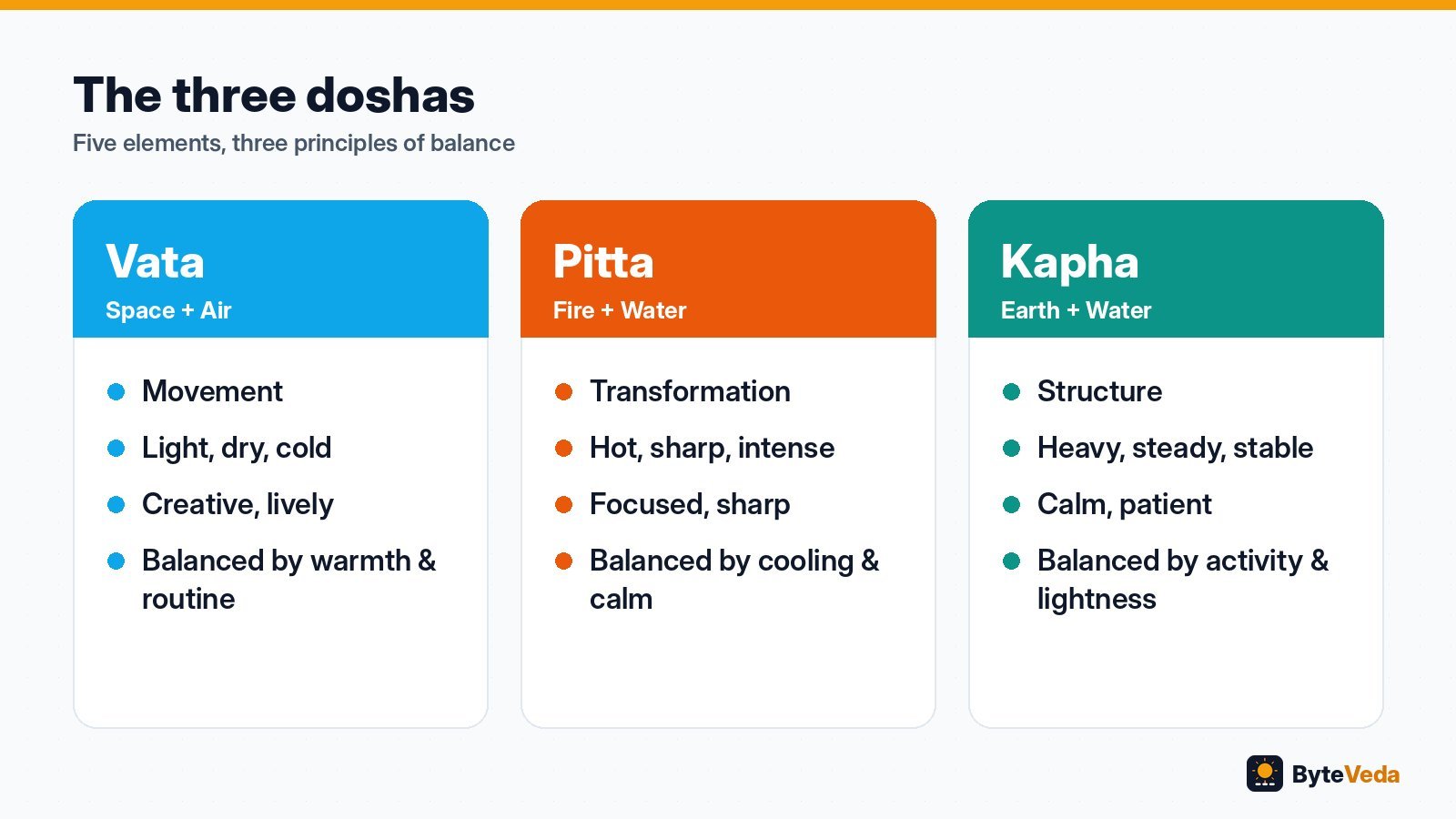
Vata — the principle of movement
- Elements: space and air
- Qualities: light, dry, cold, mobile, subtle
- Associated functions: movement, breathing, circulation, the nervous system
- When described as balanced: creative, quick-thinking, enthusiastic
- When described as out of balance: restlessness, worry, irregular routines
Pitta — the principle of transformation
- Elements: fire and water
- Qualities: hot, sharp, intense, slightly oily
- Associated functions: digestion, metabolism, body temperature, understanding
- When described as balanced: focused, determined, a sharp intellect
- When described as out of balance: irritability, impatience, overheating
Kapha — the principle of structure
- Elements: earth and water
- Qualities: heavy, slow, steady, stable, soft
- Associated functions: structure, lubrication, stamina, immunity
- When described as balanced: calm, loyal, patient, enduring
- When described as out of balance: sluggishness, attachment, resistance to change
At a glance
| Vata | Pitta | Kapha | |
|---|---|---|---|
| Elements | Space + Air | Fire + Water | Earth + Water |
| Key quality | Movement | Transformation | Stability |
| In balance | Creative, lively | Focused, sharp | Calm, steady |
| Traditionally balanced by | Warmth, routine, grounding | Cooling, moderation | Activity, lightness, stimulation |
Prakriti and vikriti
Ayurveda holds that each person is born with a unique combination of the three doshas, called prakriti — their natural constitution. Over time, diet, season, stress and lifestyle can shift this balance; the current state is called vikriti. Much of Ayurvedic guidance is about recognising the shift and gently restoring balance through routine, food and habits.
Pro tip
Online “dosha quizzes” can be a fun introduction, but the tradition itself relies on assessment by a trained practitioner. Treat quiz results as a starting point for curiosity, not a conclusion.
In Ayurveda, balance is not a fixed state you achieve once. It is something you return to, again and again, as life changes.
A note of care
This article explains traditional Ayurvedic concepts for general interest. The dosha framework is a traditional system of thought and is not a substitute for medical diagnosis or treatment. For any health concern, consult a qualified doctor; for Ayurvedic guidance, consult a registered practitioner.

