

Why Time in Nature Makes You Better at Your Desk Job
Key takeaways
- Focused screen work drains “directed attention”; natural settings may help it recover.
- Traditions from Japanese forest bathing to Indian practices value time in nature.
- Even short, regular breaks outdoors can be worthwhile.
- You do not need mountains — a park, a garden or a tree-lined street counts.
Think about the last time you solved a hard problem. Was it at your desk, staring at the screen — or on a walk, in the shower, or sitting outside?
Many people find their best thinking happens away from the desk. There may be a good reason for that.
The attention you use up at work
Psychologists Rachel and Stephen Kaplan proposed Attention Restoration Theory. The idea: focused work — reading, writing code, reviewing contracts, answering messages — uses directed attention, the effortful kind we use to concentrate and ignore distractions. It gets tired with use.
Natural environments, they suggested, engage a gentler, effortless kind of attention — watching leaves move, water flow, clouds drift. This “soft fascination” gives directed attention a chance to recover.
Traditions that knew this already
- Shinrin-yoku (forest bathing). The term was popularised in Japan in the 1980s to describe spending unhurried, mindful time among trees.
- Indian traditions. Ayurveda and yoga have long linked wellbeing to living in rhythm with nature — rising with the sun, following the seasons, practising outdoors.
- The daily walk. Many writers and thinkers throughout history made long walks part of their working routine.
Small ways to bring nature into a busy week
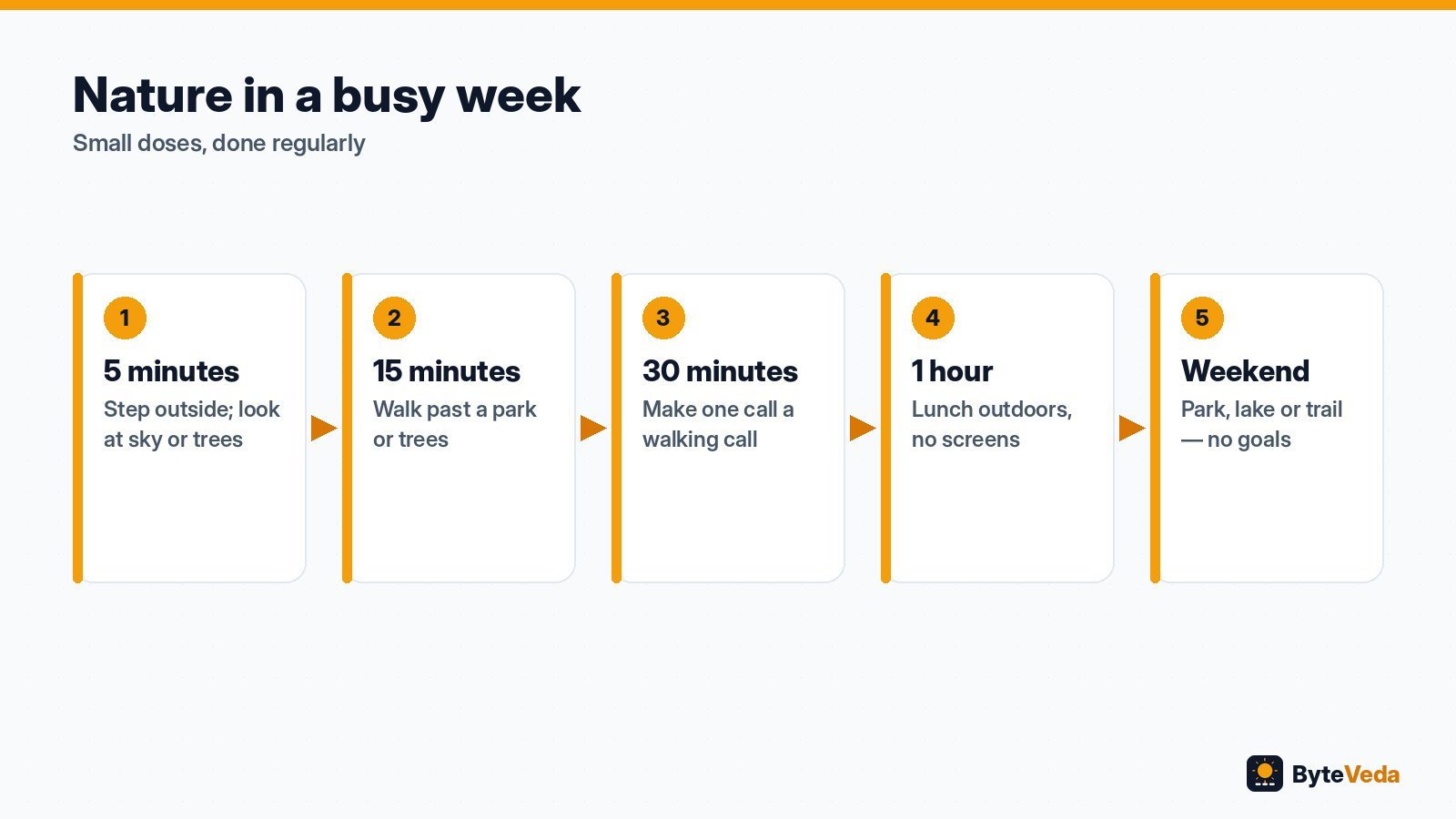
| If you have… | Try this |
|---|---|
| 5 minutes | Step outside between meetings; look at the sky or trees, not your phone |
| 15 minutes | A walk around the block, ideally past trees or a park |
| 30 minutes | Take one call a day as a walking call |
| An hour | Lunch outdoors, away from screens |
| A weekend morning | A park, lake, garden or trail — without a fitness goal |
Pro tip
Try a “no-phone walk” once a week. Leave the headphones behind and simply notice what you see and hear. Many people find ideas surface on their own.
Nature does not ask for your attention. That is exactly why it gives it back.
Bringing a little nature indoors
When getting outside is hard, small changes still help create a calmer workspace:
- Work near a window with a view of greenery where possible.
- Keep a few easy-care plants on your desk.
- Open windows for fresh air and natural light.
The bottom line
You do not need a holiday in the mountains. Regular, short moments outdoors — built into an ordinary working week — are an easy, low-cost habit that many people find makes them calmer, clearer and better at the work that matters.
