
RAG vs Fine-Tuning: Which One Does Your Enterprise AI Project Actually Need?
Key takeaways
- RAG gives a model knowledge at answer time; fine-tuning changes its behaviour.
- Choose RAG when information changes often or answers need citations.
- Choose fine-tuning for strict formats, consistent style or narrow high-volume tasks.
- Most enterprises should start with prompting, then RAG, and fine-tune last.
Almost every enterprise AI conversation reaches the same fork in the road: should we fine-tune a model on our data, or should we use retrieval-augmented generation (RAG)? The question sounds technical, but the answer is mostly about what problem you are trying to solve.
Getting it wrong is expensive. Teams fine-tune a model to “teach it our policies”, only to find it still makes things up and goes stale the day a policy changes. Others build an elaborate RAG pipeline when what they really needed was a model that writes in a very specific format.
The one-line difference
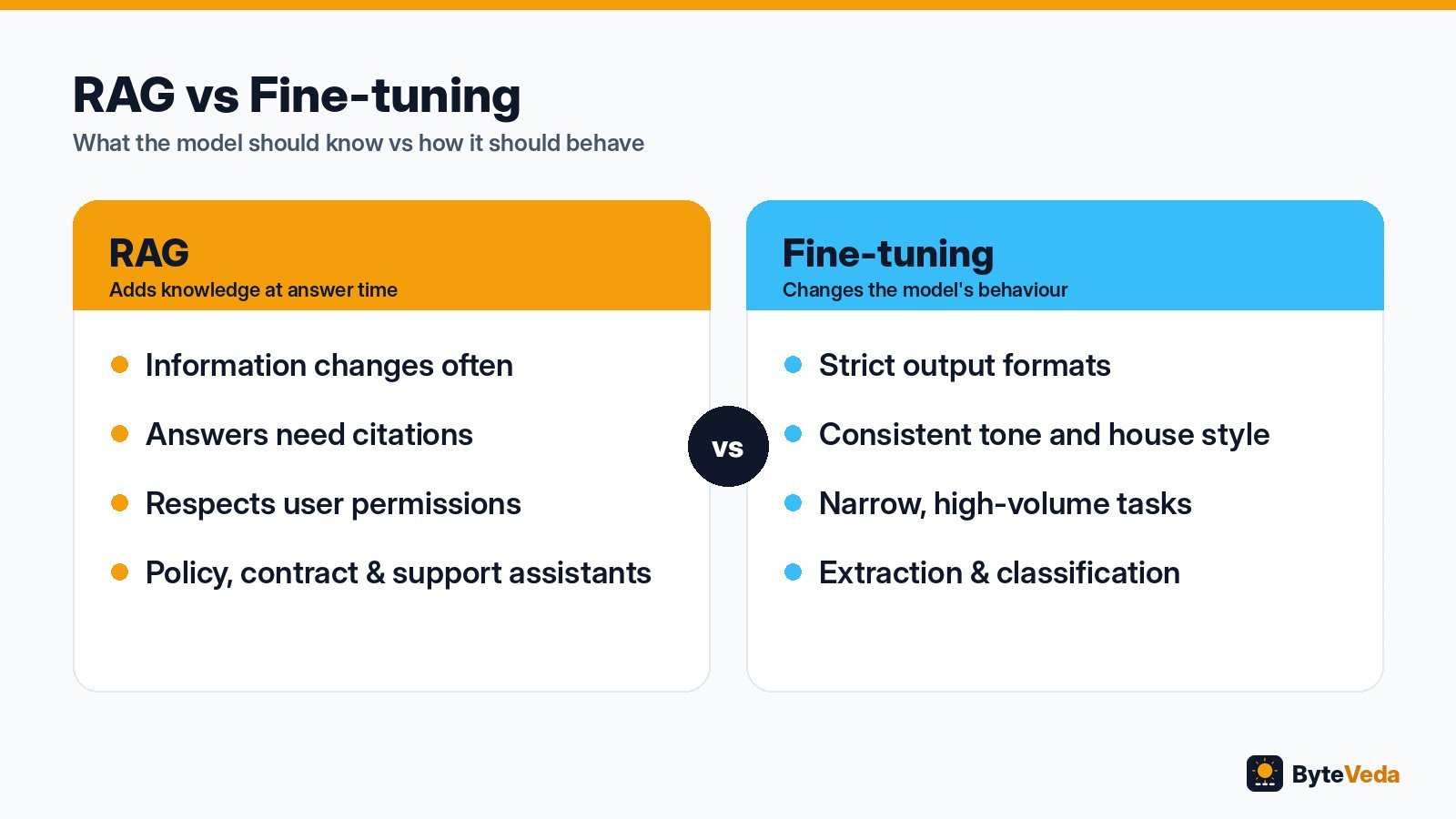
- RAG gives the model knowledge at the moment it answers. Relevant documents are retrieved from your own content and placed in the prompt, so the model answers using them.
- Fine-tuning changes the model’s behaviour. You train it further on examples so it learns a style, a format, a vocabulary or a narrow task.
A useful shortcut: RAG is for what the model should know; fine-tuning is for how the model should behave.
| RAG | Fine-tuning | |
|---|---|---|
| Solves | Missing or changing knowledge | Inconsistent behaviour or format |
| Updating | Re-index documents (minutes) | Retrain the model (days) |
| Citations | Yes — can show sources | No — knowledge is in weights |
| Access control | Can respect user permissions | Not possible per user |
| Best for | Policy, contract and support assistants | Extraction, classification, house style |
When RAG is the right choice
RAG shines when the answer lives in documents that change and that you need to be able to point to.
- Knowledge changes often. Policies, contract templates, product documentation and pricing get updated. With RAG you re-index the document; with fine-tuning you retrain.
- You need citations. Legal, compliance and support teams want to see which clause or which article an answer came from. RAG can return the source alongside the answer.
- Access control matters. In a well-built RAG system, users only retrieve documents they are allowed to see. Knowledge baked into model weights cannot be permission-trimmed.
- You want to reduce hallucination on factual questions. Grounding the model in retrieved text does not eliminate errors, but it gives the model something concrete to work from — and gives you something to check.
Typical RAG use cases: an internal policy assistant, a contract clause finder, a support bot over product docs, a “chat with our playbook” tool for legal or sales.
When fine-tuning is the right choice
Fine-tuning earns its cost when you need consistent behaviour that prompting alone cannot reliably produce.
- Strict output formats. Extracting fields from documents into a fixed structure, again and again, at scale.
- A distinctive tone or style. Brand voice, or the house style of a legal team’s drafting.
- Narrow, repetitive classification tasks. Routing tickets, tagging contract types, labelling risk levels — where you have many good labelled examples.
- Cost and latency at volume. A smaller fine-tuned model can sometimes match a larger general model on one narrow task, at lower cost per call.
What fine-tuning is not good at: reliably memorising facts. Models trained on your documents can still confuse details, and you cannot easily trace an answer back to its source.
A simple decision checklist
Ask these questions in order:
- Can a good prompt with a few examples already do the job? Try this first. Modern models are strong, and prompt engineering is the cheapest lever.
- Is the problem “it doesn’t know our information”? → Start with RAG.
- Is the problem “it knows enough, but doesn’t behave the way we need”? → Consider fine-tuning.
- Is it both? → Use RAG for knowledge and a lightly fine-tuned (or well-prompted) model for format and style.
Pro tip
Before choosing either approach, write down 20–30 real questions your users will ask, with the correct answers. This “evaluation set” will tell you more than any vendor demo.
What usually goes wrong with RAG
RAG looks simple in a demo and gets hard in production. The common failure points are rarely the model itself:
- Poor document chunking. Splitting a contract mid-clause destroys meaning. Chunk along natural structure — sections, clauses, headings.
- Weak retrieval. If the right passage is not retrieved, the best model in the world cannot answer correctly. Combining keyword search with semantic (vector) search usually helps.
- Stale or duplicate content. Five versions of the same policy in the index means five possible answers. Content governance matters more than model choice.
- No evaluation set. Build a list of real questions with known correct answers and test against it every time you change something.
What usually goes wrong with fine-tuning
- Too little or low-quality training data. A few hundred inconsistent examples teach inconsistency.
- Fine-tuning to inject knowledge. It is the wrong tool for facts that change.
- No plan for re-training. Base models improve quickly. A fine-tune done on last year’s model may be beaten by this year’s model with a good prompt.
The practical answer for most enterprises
For most business use cases — especially in legal, compliance, HR and support — start with a strong prompt, add RAG for your knowledge, and only fine-tune when you have a proven, high-volume task with clear examples.
That order keeps costs low, keeps answers traceable, and lets you swap in better base models as they arrive without starting over.
The best AI architecture is usually the simplest one that passes your evaluation set. Start there, measure, and add complexity only when the numbers tell you to.