
The AI-Augmented Professional: 6 Skills That Will Matter Most
Key takeaways
- AI raises the floor; human skills raise the ceiling.
- Six skills stand out: problem framing, critical review, domain depth, communication, systems thinking and continuous learning.
- Each can be practised deliberately — starting this week.
When everyone has access to the same powerful AI tools, the difference between average and excellent work comes back to the person using them. Here are six skills that consistently separate the professionals who thrive.
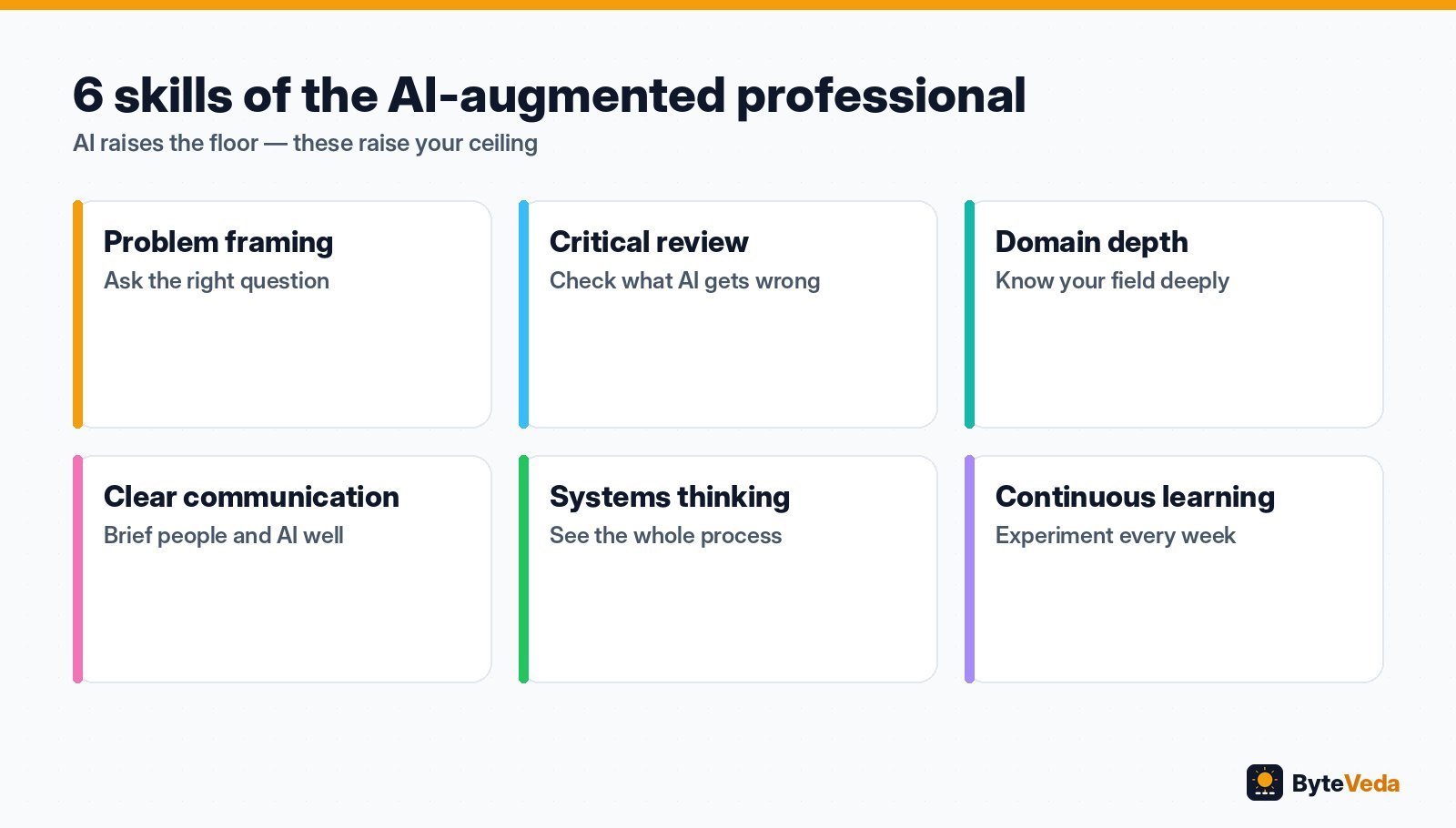
1. Problem framing
AI is very good at answering questions. It is far less good at knowing which question to ask. Professionals who can turn a messy situation into a clearly defined problem get dramatically better results — from colleagues and from AI.
Practise it: before starting any task, write one sentence: “The problem I am solving is… and success looks like…”
2. Critical review
AI output is fluent, confident and sometimes wrong. The skill of reading critically — checking facts, spotting gaps, testing assumptions — becomes more valuable, not less.
Practise it: for every AI-assisted piece of work, list three things that could be wrong and check them.
3. Deep domain expertise
Generic knowledge is now abundant. Deep, specific knowledge of an industry, a regulation, a technology stack or a client base is not. It is also what lets you spot subtle errors.
Practise it: go one level deeper in your field each quarter — a certification, a hard project, or teaching a topic to others.
4. Clear communication
Writing a good prompt and writing a good brief for a colleague are the same skill. So is explaining a recommendation to a decision-maker.
Practise it: rewrite your next important email in half the words.
Pro tip
A simple test of clear thinking: can you explain your project to someone outside your field in two minutes? If not, the AI probably cannot help you with it well either.
5. Systems thinking
Value increasingly comes from connecting tools, data and processes — understanding how a change in one place ripples through others.
Practise it: map one end-to-end process in your organisation, including every system it touches. You will find improvement opportunities immediately.
6. Continuous learning
The tools you use today will change within a year. The habit of experimenting, learning quickly and sharing what you learn compounds over a career.
Practise it: spend 30 minutes a week trying one new AI capability on real work.
| Skill | Quick weekly habit |
|---|---|
| Problem framing | Write the problem statement first |
| Critical review | Check three things in every AI output |
| Domain depth | Go one level deeper each quarter |
| Communication | Halve the length of one email |
| Systems thinking | Map one process end to end |
| Continuous learning | 30 minutes of hands-on experimenting |
AI raises the floor for everyone. Your skills decide how high your ceiling goes.

