
7 Mistakes Companies Make When Implementing a CLM Platform
Key takeaways
- CLM projects usually fail on process, data and adoption — not technology.
- Simplify templates and approvals before you automate them.
- Plan legacy contract migration and integrations from day one.
- Launch small, measure, and expand.
Buying a contract lifecycle management platform is the easy part. Making it the place where contracts actually get done is harder. Across many implementations, the same mistakes appear again and again.
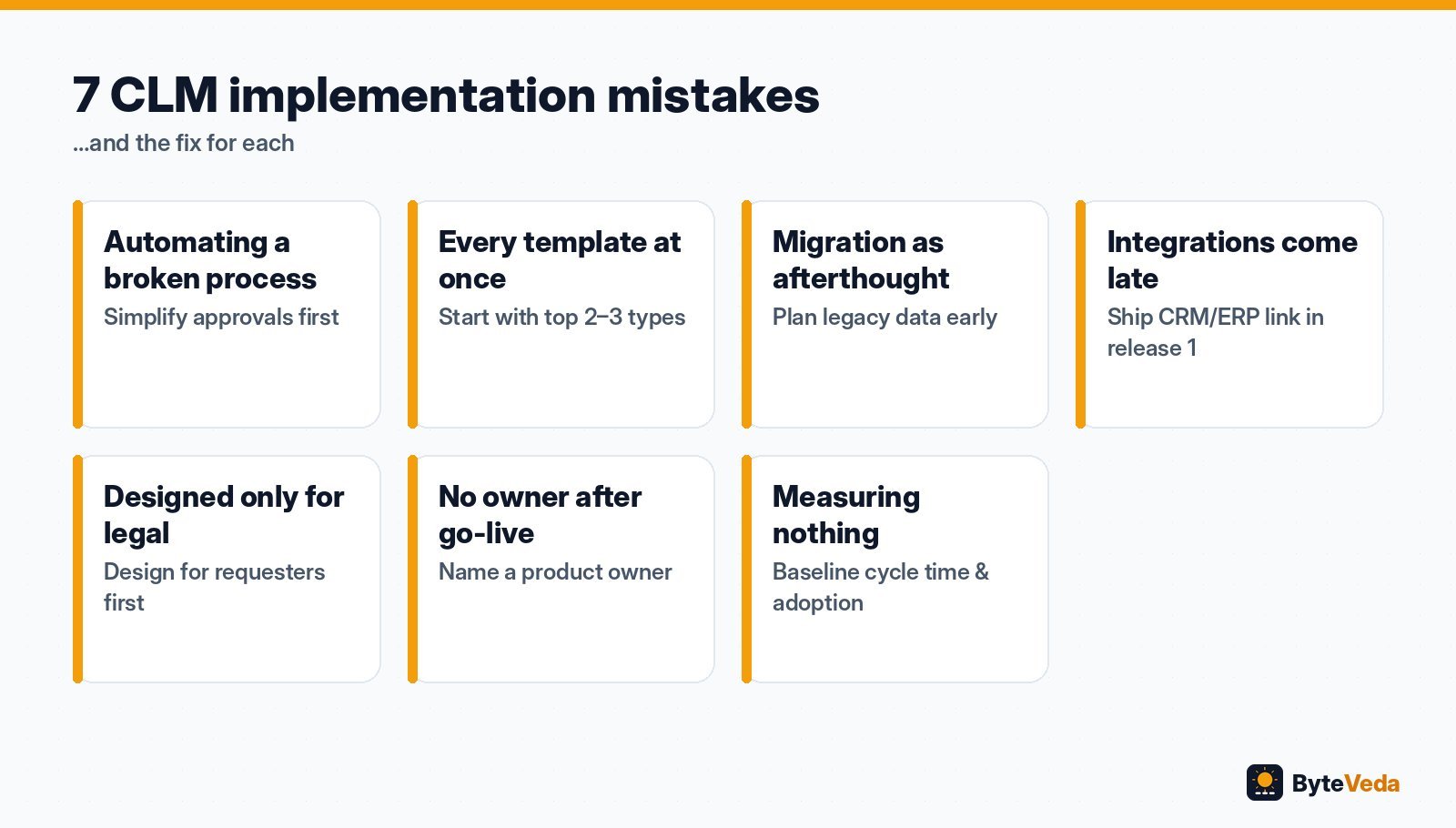
1. Automating a broken process
If today’s NDA needs five approvals, a CLM system will faithfully automate five approvals. Before configuration, ask why each step exists. Many approval chains shrink dramatically once someone challenges them.
Fix: run a short process-simplification workshop before any build work.
2. Bringing every template at once
Teams often try to load fifty templates on day one. Each one needs clauses, fields, conditional logic and testing. The project slows, and users wait months for value.
Fix: start with the two or three highest-volume contract types. Add the rest in waves.
3. Treating legacy migration as an afterthought
Thousands of historical contracts sit in shared drives. Without them, the repository is incomplete and reporting is misleading.
Fix: decide early which contracts to migrate (often only active ones), what metadata to capture, and whether to use AI-assisted extraction with human review.
4. Ignoring integrations until late
Sales will not leave the CRM to request a contract. Finance needs contract values in the ERP. If these connections arrive “in phase two”, adoption stalls in phase one.
Fix: include at least the CRM or procurement integration in the first release. Document data flows in an integration requirements document from the start.
Pro tip
For every integration, agree the “system of record” for each field. If both the CRM and the CLM can edit the customer address, you will eventually have two different addresses.
5. Designing only for the legal team
Lawyers are the power users, but most contract requests come from sales, procurement and HR. If the intake form is long and confusing, they will go back to email.
Fix: design the requester experience first. Short forms, plain language, and status visibility.
6. No clear owner after go-live
Once the implementation partner leaves, who updates templates, adds users, adjusts workflows and fixes integration errors?
Fix: name a CLM product owner, document admin procedures, and train at least two internal administrators.
7. Not measuring anything
Without baseline numbers, you cannot prove value — and the next budget conversation gets harder.
Fix: measure before and after:
| Metric | Why it matters |
|---|---|
| Average contract cycle time | Speed of doing business |
| Contracts handled by self-service | Legal time saved |
| Renewals actioned before deadline | Revenue and cost protection |
| User adoption rate | Whether the system is really used |
The software is rarely the reason a CLM project fails. Process, data and people almost always are.
The pattern that works
Simplify, start small, integrate early, design for requesters, and measure. Do those five things and most of the common CLM failures simply do not happen.

